
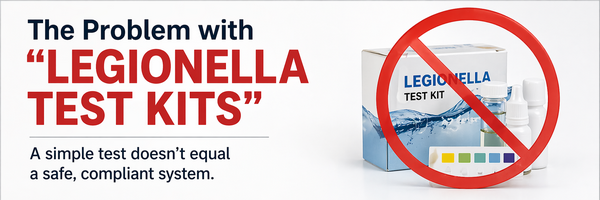
If you’ve searched for a “legionella test for dentists”, you’ve probably seen quick DIY test kits promoted as a fast, low-cost solution.
They look convenient. They’re not.
For UK dental practices, relying on a simple test kit can leave you non-compliant, exposed to risk, and vulnerable during a CQC inspection.
Let’s break down what’s really required—and why proper Legionella control goes far beyond a single test.
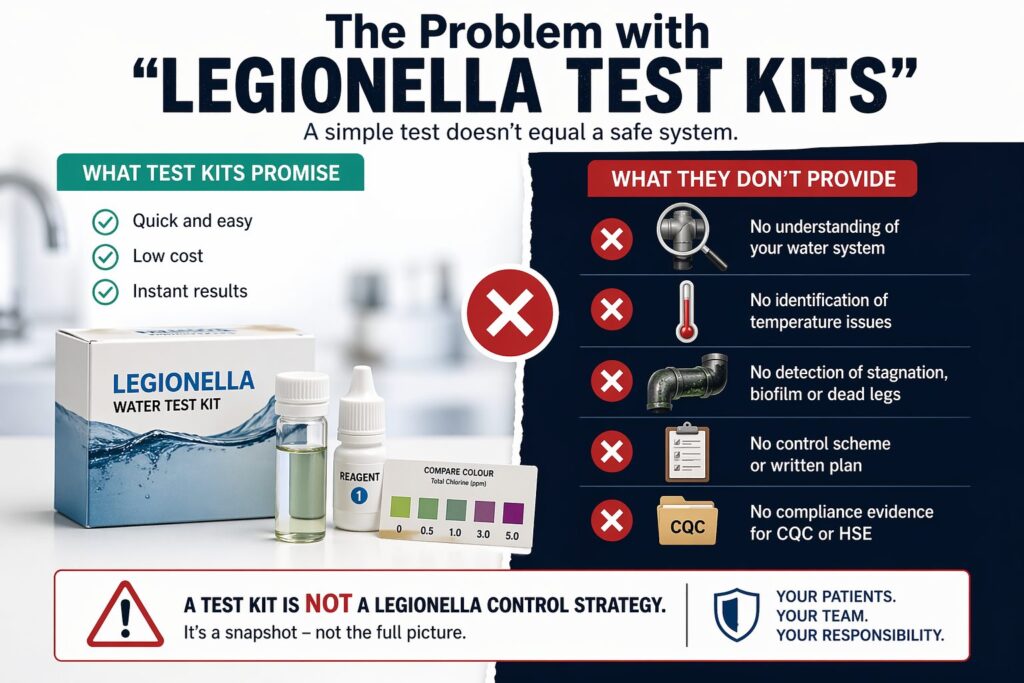
The Problem with “Legionella Test Kits”
Test kits typically offer:
- A single water sample
- A basic indication of bacterial presence
- Minimal interpretation or follow-up
What they don’t provide:
- A full understanding of your water system
- Identification of risk points (e.g. stagnation, temperature failures, biofilm)
- A compliant control scheme
- Evidence for inspection
In a dental setting, this is critical.
Dental practices generate high levels of aerosol exposure during procedures—one of the key risk factors for Legionella transmission .
So a “pass/fail” dip test doesn’t answer the real question:
Is your system safe, controlled, and legally compliant?
What UK Guidance Actually Requires
Dental practices must comply with a framework of regulations and guidance, including:
- Health and Safety Executive ACoP L8
- HSG274 Parts 2 & 3 (water systems control)
- Care Quality Commission (CQC) requirements
- HTM 01-05 (dental decontamination guidance)
These don’t ask for a “test”.
They require a complete system of risk assessment, monitoring, and control.
That includes:
- Identifying sources of risk
- Implementing a written control scheme
- Ongoing temperature monitoring
- Regular flushing and maintenance
- Dipslide testing of dental unit waterlines (DUWLs)
- Keeping records for at least 5 years
A test kit alone ticks none of these boxes.
Why Dentistry Is Higher Risk
Legionella becomes dangerous when:
- Water is between 20–45°C (ideal growth range)
- There is stagnation or biofilm
- Aerosols are generated and inhaled
Dental practices hit all three.
In fact, dental unit waterlines (DUWLs) are specifically highlighted as risk systems due to:
- Fine tubing (biofilm risk)
- Intermittent use (stagnation)
- High aerosol production during treatment
That’s why guidance doesn’t rely on occasional testing—it requires continuous control.
What a Compliant Approach Looks Like
A proper Legionella strategy for dentists includes:
1. Legionella Risk Assessment (LRA)
A full-site review of:
- Water systems
- Usage patterns
- Patient/staff exposure risk
- Equipment (including DUWLs, RO systems, cylinders)
2. Written Control Scheme
A documented plan covering:
- Responsibilities (Duty Holder, Responsible Person)
- Monitoring schedules
- Maintenance procedures
3. Ongoing Monitoring
Not a one-off test, but continuous control:
- Weekly flushing
- Monthly temperature checks
- Quarterly microbiological testing (e.g. dipslides)
- Annual servicing
4. Record Keeping
Essential for compliance:
- Logbooks
- Test results
- Maintenance records
- Audit trail for inspectors
Without this, even a “clean” test result won’t protect you.

What a Compliant Approach Looks Like
A proper Legionella strategy for dentists includes:
1. Legionella Risk Assessment (LRA)
A full-site review of:
- Water systems
- Usage patterns
- Patient/staff exposure risk
- Equipment (including DUWLs, RO systems, cylinders)
2. Written Control Scheme
A documented plan covering:
- Responsibilities (Duty Holder, Responsible Person)
- Monitoring schedules
- Maintenance procedures
3. Ongoing Monitoring
Not a one-off test, but continuous control:
- Weekly flushing
- Monthly temperature checks
- Quarterly microbiological testing (e.g. dipslides)
- Annual servicing
4. Record Keeping
Essential for compliance:
- Logbooks
- Test results
- Maintenance records
- Audit trail for inspectors
Without this, even a “clean” test result won’t protect you.
The Real Risk of Taking Shortcuts
Using a simple test kit might feel like due diligence—but it can create false confidence.
Common failures seen in practices include:
- Incomplete or missing records
- Poor DUWL maintenance
- Inadequate monitoring frequency
- Lack of a clear Responsible Person
These are exactly the issues flagged during professional assessments—and during inspections.
Why Practices Choose DWS
This is where a specialist provider like Dental Water Safety (DWS) stands apart.
Instead of a single test, you get:
- Full Legionella Risk Assessment aligned with UK standards
- A complete compliance framework
- Practical support for your team
- Clear documentation for inspections
- Ongoing monitoring and guidance
In other words: not just a result—but control, evidence, and peace of mind.
Bottom Line
If you’re searching for a “legionella test for dentists”, what you actually need is:
A compliant Legionella control system—not a shortcut test.
Test kits might tell you something.
A proper approach keeps your patients safe, your practice compliant, and your risk under control.
If you want, Jay Dog, I can tighten this further for SEO (meta title, H1 variations, internal linking targets for DWS, schema markup, etc.) or adapt it into a landing page that converts.